Landscape Architecture: Why Experience Makes a Better Home
By Garabedian Properties
When most people think about landscaping, they think about what happens at the end of a build — the grass, the plants, the finishing touches. What they rarely consider is how much of the outdoor experience is shaped, or lost, long before a single shrub is planted.
On this episode of Uniqueness… “Built-In,” Mike Garabedian sits down with Jason Osterberger of Osterberger Design Group, a landscape architect whose work has shaped some of the most thoughtfully considered luxury properties in North Texas. The conversation covers everything from drainage engineering to water features to dog yards — and makes a compelling case for why a landscape architect belongs at the table from day one.
GET IN TOUCH WITH OSTERBERGER DESIGN GROUP
📞 972.304.8700 | 🌐 Osterberger Design Group | 📩 Office@OsterbergerGroup.com | 📍 531 W. Bethel Road Coppell, TX 75019
Landscape Architect Versus Landscaper: Understanding the Distinction
Oftentimes, these terms are used interchangeably, but they should not be.
As Jason explains, a landscape architect is “an educated, trained individual who carries a degree from a university that will address the whole experience — site development and the wish list from a client and turn that into a reality for them.” A landscaper, by contrast, is the professional hired to install a landscape architect’s plan. Both are essential. They are not the same.
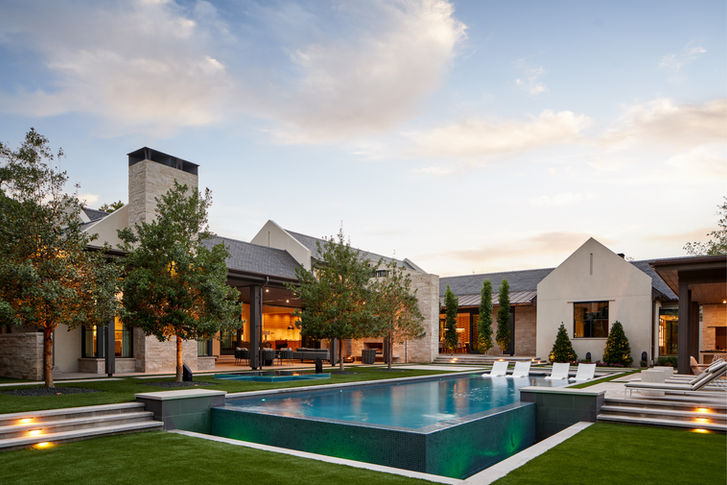
The distinction becomes especially clear when you examine the scope of what a landscape architect produces. On a recent project that Garabedian Properties completed alongside Osterberger Design Group, the landscape plan set ran to fifteen pages — comparable in complexity to the architectural drawings for the house itself. That depth of documentation reflects a fundamentally different approach to the exterior environment.
A landscaper will install a plant and follow a plan. A landscape architect establishes the experience — not just what the outdoor space looks like, but how a family will actually live in it.
Why You Need To Think About Landscaping At The Beginning of Your Project
One of the clearest themes in this conversation is the cost — financial and experiential — of engaging a landscape architect too late in the process.
Jason describes his ideal entry point: “I like to say I think the best place for landscape architects to start is from the beginning.” That means working alongside the builder and the architect to evaluate lot selection, assess drainage conditions, understand how the family wants to live both inside and outside, and account for how the family’s composition may shift over the life of the home. A young family in the middle of a two-year build may have more children by move-in day. Drivers where there were once toddlers. An empty nest where there was once a full one.
Planning for Landscaping Early is Part of What Distinguishes this Practice
On the Garabedian Project, input from Jason during the design phase led to revisions in the master plan that improved the final outcome — revisions that would not have been possible had the landscape architect been brought in after construction was complete. As Mike reflects in the episode, many Owners draw the house, place the pool, and call in a landscaper near the finish line. The results can be beautiful. They can also be limited by the decisions that were locked in before anyone thought about the outdoor experience.
The financial argument is equally direct. As Jason puts it: “When you plan ahead and spend the money, your experience is better — and while you may spend a little bit up front, you are actually going to save it on the end.” Not planning ahead, he notes, is a bit like going to the grocery store without a list. You will spend more, and you will still come home without what you actually needed.
Drainage and Grading: The Most Underrated Decision on Any Lot
Every experienced builder in North Texas has a drainage story. Jason describes grading and drainage as “the most underrated item that happens — but the item that will affect your landscape the longest, and negatively impact the house, the landscaping, materials, things like that.”
On the Lakeside Project discussed in the episode, the finished floor elevation of the house and the surrounding grade were very close — a condition that required deliberate intervention. The solution was a French drain installed against the foundation, with exposed decorative gravel creating what became both a functional barrier and a distinct design element. As Jason describes it, that barrier — approximately eighteen inches deep and filled with gravel — allows water to hit the house and run down, rather than hit the house and run through.
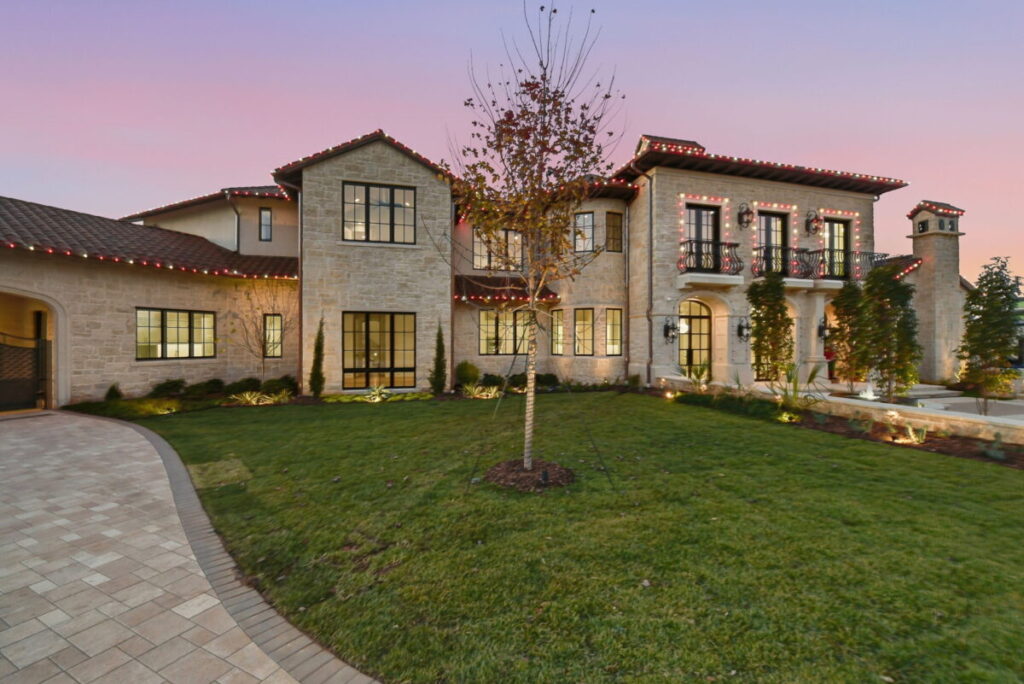
How Weather Events Impact Landscaping in Texas
Texas rainfall does not permit half-measures. Irrigation runs several times a week under normal conditions; a significant rain event can overwhelm a site that was not properly engineered from the start.
The same project required sump pumps — not a preferred solution, but a necessary one. Because the house served as a physical barrier between the front yard and the lake behind it, conventional gravity drainage was insufficient. Positive drainage had to be engineered in. As Jason explains:
“Here in Texas, when we get a big rain, there is not much that can keep up with it. Having positive flow drainage as well as a sump pump — we are doubling our efforts.”
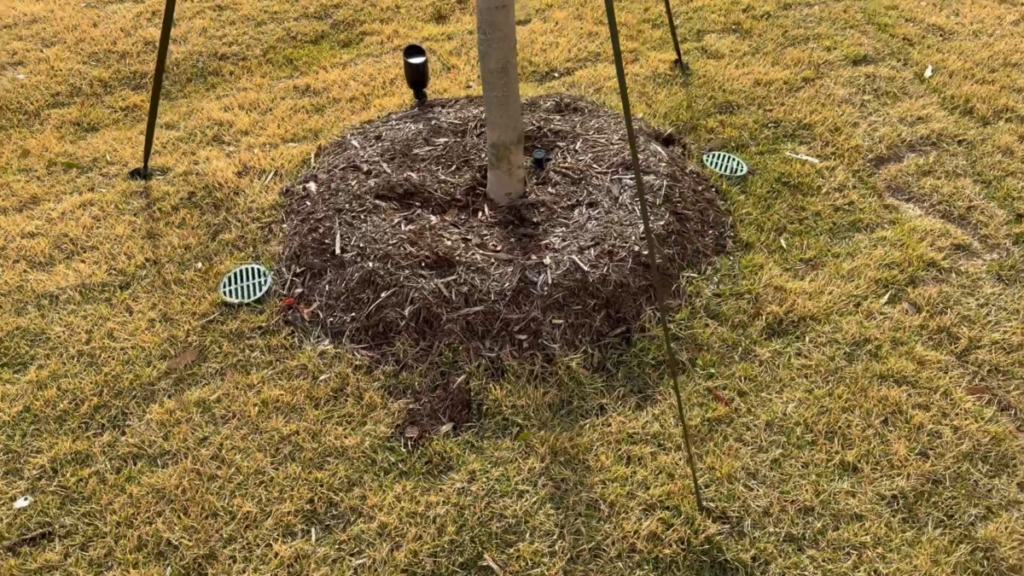
For large tree installations, the engineering extends underground as well. Osterberger Design Group installs gravel bases beneath significant trees, with check pipes capped at grade that allow their maintenance crews to monitor water retention at the root level each week. Texas clay compacts as you dig deeper, creating conditions that can suffocate a newly planted tree before it ever establishes. The gravel base and monitoring system allow the tree to acclimate, as Jason says, “peacefully, without much disturbance.” Trees that are not given that opportunity get sick — sometimes more than once. Replacing a tree may be covered under warranty. The years of lost growth are not.
Turf: Natural, Synthetic, and the Case for Both
The conversation on grass is more nuanced than the question of natural versus artificial.
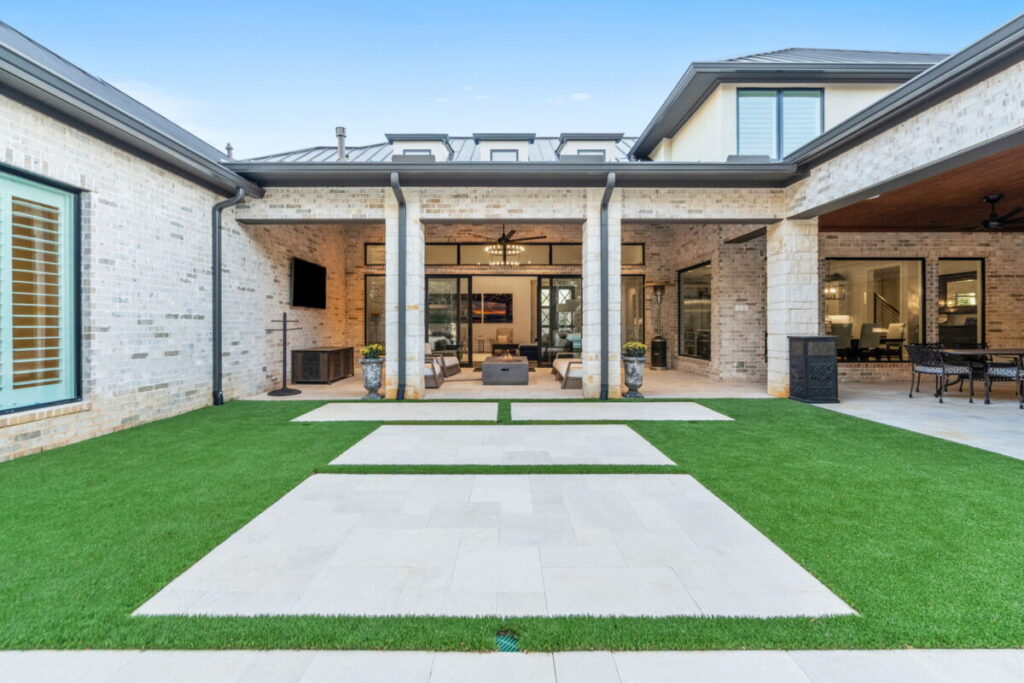
Jason’s position is that most properties benefit from a thoughtful combination of both. Synthetic turf technology has advanced considerably — what was once a product he would have advised against without hesitation is now, in his view, an appropriate solution in specific conditions: tight or shaded areas with poor drainage, high-traffic zones, spaces that benefit from year-round visual consistency, or households with pets.
GET IN TOUCH WITH OSTERBERGER DESIGN GROUP
📞 972.304.8700 | 🌐 Osterberger Design Group | 📩 Office@OsterbergerGroup.com | 📍 531 W. Bethel Road Coppell, TX 75019
Natural grass, in his estimation, offers something synthetic cannot: “the opportunity to be in touch with nature, to have the seasonal change that happens — a place for kids to run and play and do their things.”
Installation method matters as much as material selection. For natural grass, Osterberger Design Group establishes grade first, then lays a sandy loam base that gives new root systems loose soil to penetrate and allows irrigation water to move through rather than pool at the surface. For synthetic turf, they compact a four-inch decomposed granite base until it achieves near-concrete density — specifically to reduce the movement that North Texas soil is known to produce. An improperly prepared synthetic turf installation can shift, buckle, and wash out. The prep process is not optional; it is the product.
Continuity: When the Inside and the Outside Speak the Same Language
Before beginning any design, Jason meets with the interior designer. Color palettes. Material selections. Flooring choices. All of it informs what happens outside.
“When a person is inside the home and they look out,” he explains, “there is continuity between the two. The flooring inside and the flooring outside — when they meet, I want to make sure that they marry each other, that there is some kind of communication that happens between the two of them.”
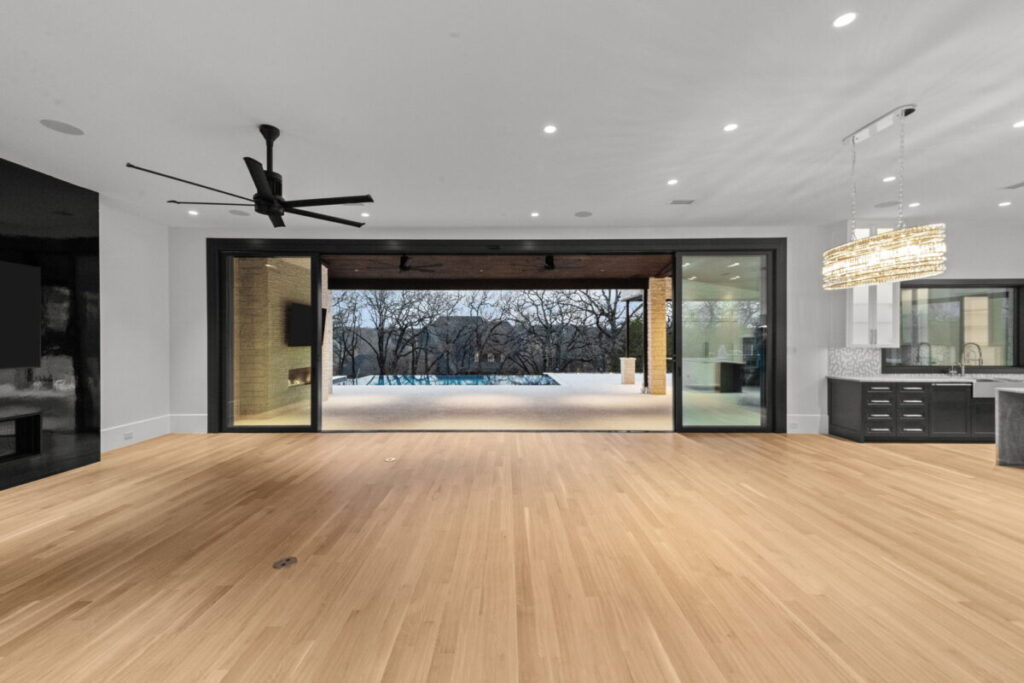
That continuity does not happen by accident. It requires the neighborhood’s visual language, the client’s intent, the interior designer’s direction, and the landscape itself — sun exposure, shade coverage, site conditions — to all be in conversation before a single material is specified. When those conversations are siloed or delayed, the result is two distinct worlds placed side by side. When they are integrated from the start, the home reads as a single, coherent experience.
Water, Fire, and the Elements That Animate a Property
Not all design decisions are structural. Some are atmospheric.
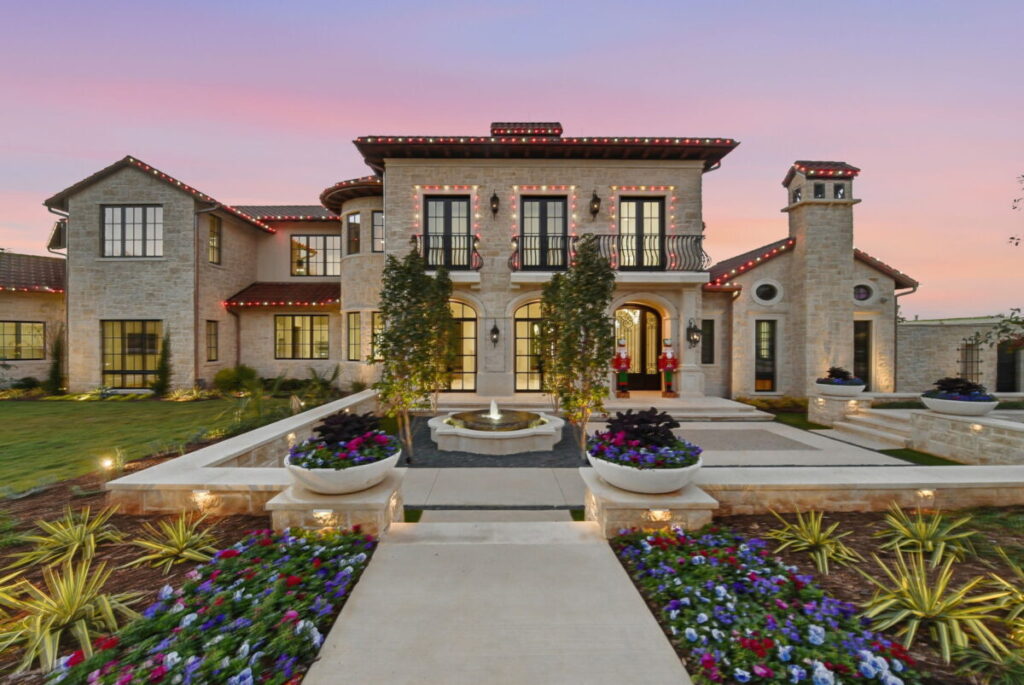
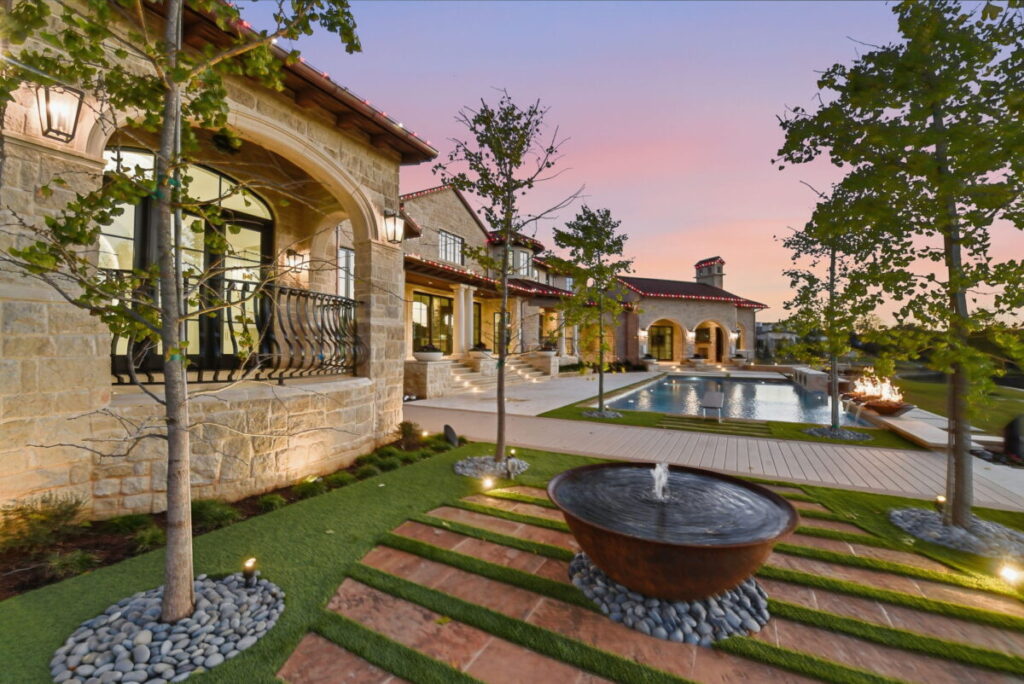
On the Lakeside Villa project, Jason commissioned and helped design a front courtyard fountain. The elevation change on that particular lot created a natural opportunity — an exterior foyer of sorts, a transitional space between the street and the home’s entry. The fountain became the focal point from three vantage points simultaneously: the dining room, the approach to the front door, and the interior of the courtyard during entertaining. Because the dining room doors open toward the front, Owners needed a reason to open them without feeling exposed to the street. The courtyard — anchored by the fountain — gave them that reason.
How Water Serves as a Practical Element
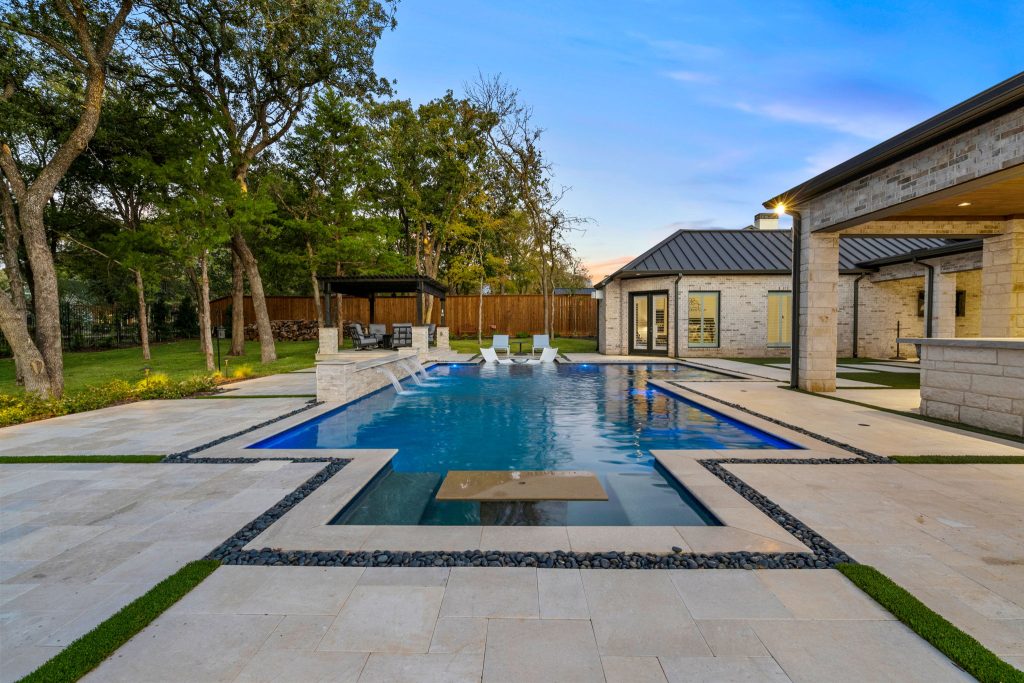
Water’s role is practical as well as visual. On a lot near a busy road, running water absorbs ambient noise without demanding attention. As Jason observes: “Water commands attention. People like to hear water, see water, the movement of water, the reflection in water. Water is crucial in the landscape. It brings it to life.”
Fire Encourages Gathering
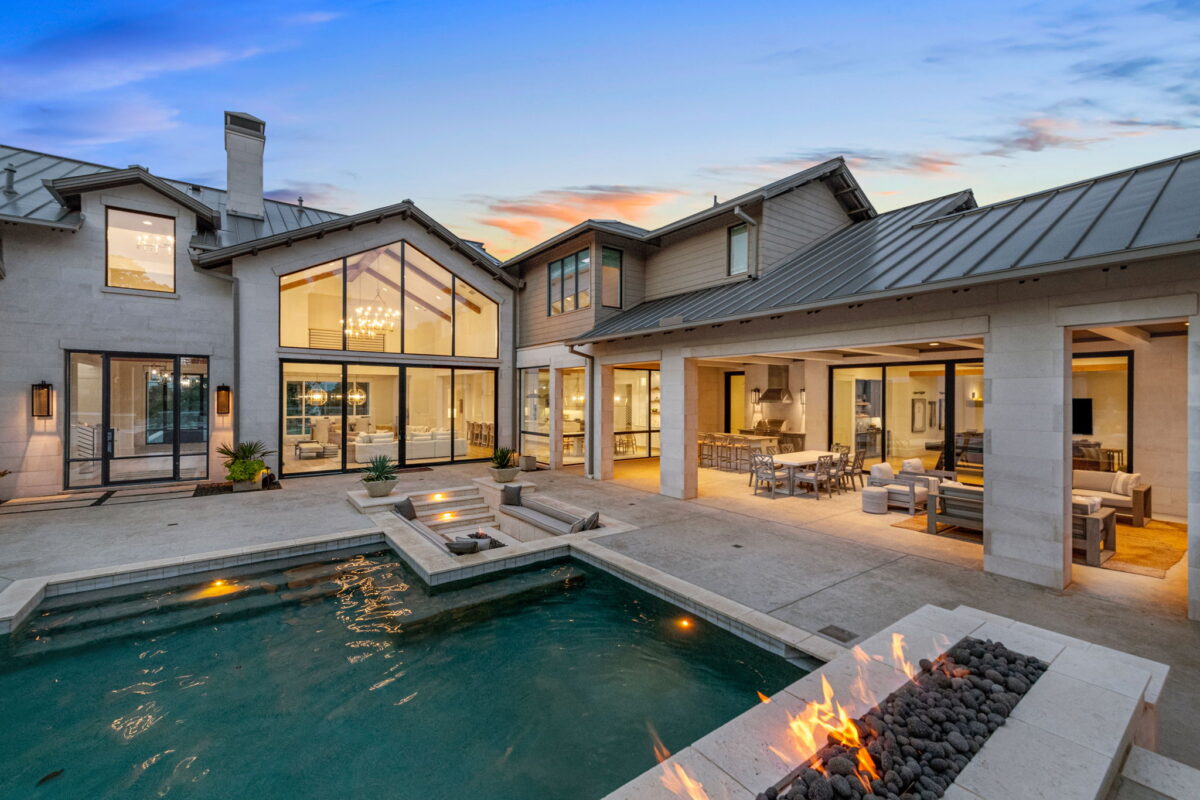
Fire serves a different but complementary function. It encourages gathering. It creates movement — specifically the quiet, natural movement of a flame that draws and holds the eye in a way that static lighting cannot. With smart home technology, a fire feature can be ignited remotely, which means it can be burning by the time guests arrive.
What is often overlooked in fire feature planning is gas load. If a home includes a fireplace, a spa heater, an outdoor grill, and a fire pit, the cumulative gas demand may exceed what a residential meter can supply. On at least one project, that gap was not discovered until the Owners could not run their grill and fire pit at the same time. Identifying the total load at the planning stage — and sizing the meter and supply lines accordingly — resolves a problem that is very difficult and expensive to correct later.
Dog Yards, Plant Scale, and the Mistakes Worth Avoiding
Two observations from Jason that do not fit neatly into any single category, but are worth noting directly.
The first: dog yards. On a client’s third custom home, Jason proposed reworking the architecture of the primary bath to include a door opening to a small artificial turf courtyard. Essentially, a dedicated space where the dogs could go out at night without requiring a trip through the full yard. The architect agreed. The client was, in his words, incredulous — and then immediately on board. The concept has since become a recurring feature in Osterberger Design Group’s work. For households where dogs are a genuine priority, designing for them from the start eliminates a daily friction that no amount of landscaping can fix after the fact.
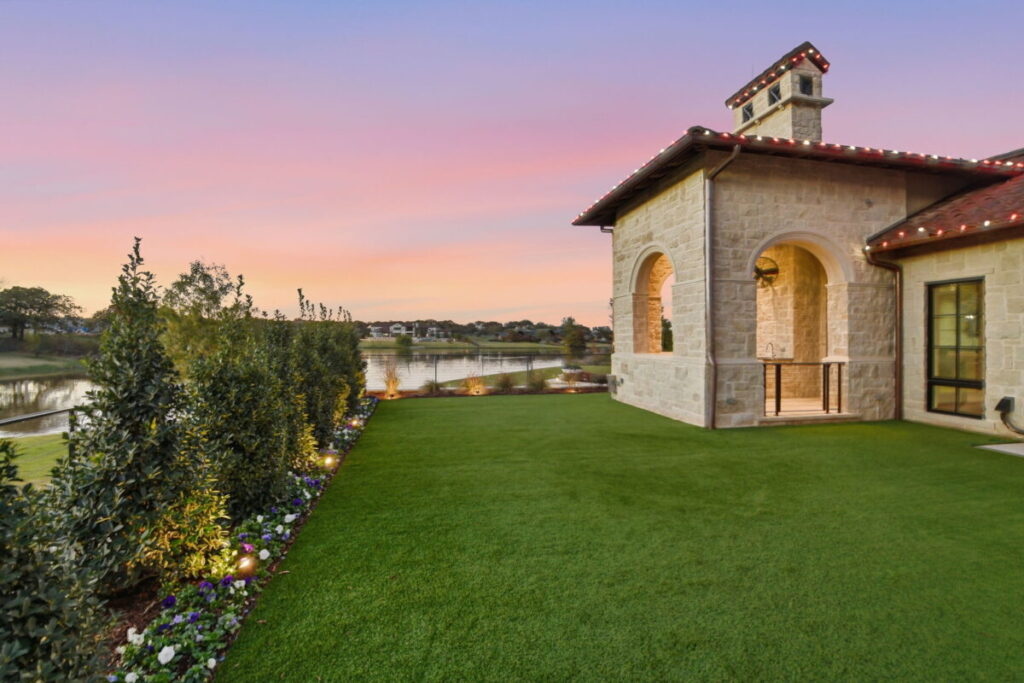
The second: plant scale. Two of the more common and costly landscape mistakes involve treating plant specifications as interchangeable and ignoring mature plant size during selection. A five-gallon holly and a thirty-gallon holly are not the same plant placed in the design at different price points. Scale determines how a plant reads against the house — whether it grounds the architecture, disappears against it, or eventually overpowers it. As Jason stated:
“What does it look like in the landscape? How does it make the house read?”
Plants that are installed small and placed too close together may look sparse at installation and become an overgrown tangle within a few seasons. Plants that mature to a height or width that conflicts with a window or walkway require cutting that damages their form. None of these outcomes are difficult to anticipate. They simply require looking ahead.
Maintenance That Thinks Ahead
A landscape is not a finished product. It is a living environment under the management of weather, irrigation, seasonal change, and time. Osterberger Design Group extends their practice through ongoing maintenance. This is not as a separate service, but as a logical continuation of the design process. As Jason describes it:
“Conceptual to completion and beyond. Our maintenance program allows for us to maintain the design intent.”
That means weekly monitoring of irrigation systems, adjustments for rain and drought conditions, and video inventories of ongoing plant health. For properties where entertaining is a must, seasonal color changeovers are also offered.
During a recent freeze event, the team was on site wrapping plants before Owners had to ask. Jason monitors irrigation systems remotely from his phone before going to bed each night. As he puts it:
“I want to be that person that is in partnership with the client so that they do not have to worry. My job is to maintain their property, [and] to think ahead of what you need next.”
Osterberger Design Group
To explore how a landscape architect can shape your next project, reach out to Jason Osterberger and his team directly:
GET IN TOUCH WITH OSTERBERGER DESIGN GROUP
📞 972.304.8700 | 🌐 Osterberger Design Group | 📩 Office@OsterbergerGroup.com | 📍 531 W. Bethel Road Coppell, TX 75019
At Garabedian Properties, we select Professional Partners who share our commitment to building homes that deliver on their promise; not just on delivery day, but for the decades that follow. Landscape architecture, done with this level of care and foresight, is not the foundation of every great home.
To learn more about how we approach the home building process, or to begin a conversation about your project, contact us at 817.748.2669 or visit us online.