
Episode 7 Recap – Uniqueness… “Built-In”
Financing a custom home is not the same as financing a resale. With a custom home, we understand the timelines are longer with substantially larger loan sizes. This also means complex documentation. For many of our Owners — who are business Owners or highly commissioned professionals — the structure must be flexible.
In this episode, we sat down with Mark Goodwin of Federal Savings Bank to walk through how construction financing works today — and how Owners can position themselves wisely. There is a lot of information to cover, so if you need help understanding any of these topics, we encourage you to reach out at any time.
The One-Time Close: Then vs. Now
Just to put things in perspective, in 2004, we completed a 7-day one-time close on a custom home. That is pretty much impossible to do now because of the size of homes and federal reserve requirements placed on banks — regulations have changed.
Now, we see large jumbo construction loans that are typically structured as two-time closes:
One-time closes still exist for smaller loan amounts, but most estate-level homes will follow a two-phase structure.
Approval Timeline: 18 Days to Approval, 21 to Close
For a well-prepared Owner:
- Approval can happen in approximately 18 days
- Closing can happen in approximately 21 days
- Lending can be done across the country
- A survey on the land can be coordinated during that window

Loan-to-Value (LTV)
Loan-to-value drives everything.
Example: 90% of $2.5 million
→ Owner puts 10% down
→ Property is re-appraised at completion
When the permanent loan is moved to the secondary market, additional equity may be required to meet investor guidelines.
Common Structures:
- 85% LTV up to $3–$3.5 million (Owner puts 15% down)
- 90% LTV up to roughly $2–$2.5 million
- 80% LTV for higher price points
- $5M–$10M projects → LTV comes down significantly
- $8M–$10M homes → 30% down is common
As project size increases, required equity increases. But here is the key:
Many Owners already own their dirt.
If you paid $1M for your lot and today it appraises for $1.5M, you receive full equity credit for that appreciation.
Self-Employed Owners
Roughly 70% of borrowers in this space are highly commissioned or self-employed. A good lender will understand:
- Multiple business entities (evaluating YTD P&L statements)
- Depreciation (adding back)
- Startup costs
- One-time losses
- Variable year-to-year income (Owners often take capital distributions at the end of the year)
This is where the construction loans offer flexibility.
Lower down payment up front > Capital taken later in the year > Additional equity applied at permanent financing
That flexibility is critical for business Owners.
Documentation: What You Actually Need
Most lenders want:

Some programs even allow one year tax return options at 80% LTV, but we recommend you gather at least two years.
Pro tip: Create a folder on your computer now. Keep tax returns, business returns, and updated financials organized. That alone can shorten your timeline significantly.
Bank Statements & Reserves
Do you need statements for everything? No. You only need to show enough assets to:
For example on a $2M loan, 12 months of principal and interest may be required as reserves.
Your loan officer should guide what is necessary. Provide what is needed — not every small checking or savings account with $5K or $10K. In fact, over-documentation can slow the process.
The Draw Process: Where Execution Matters
Construction lending involves what is called a “draw process” where lenders release loan funds in phases as work is completed rather than all at once. After each milestone, the builder submits documentation, the lender orders an inspection, and once approved, funds are disbursed to cover labor and materials.

Mark explains how Federal Savings Bank manages this phase of the process:
- All draw processing is handled in Southlake
- Inspection happens quickly
- Within 48 hours, funds are sent to the builder into a designated account
Goodwin gives an example of how this improves vendor relationships:
If Pella Windows requires a 50% deposit on a $200,000 window package, the lender can issue that deposit directly to the vendor.
This allows businesses to keep projects and cashflow moving.
12-Month Construction Loan Structure
Standard structure:
- 12-month construction loan
- If in good standing, extended another 12 months
- Can extend again if needed
That protects Owners in architecturally complex builds that may stretch beyond a year. LTV typically ranges from 90%–80% depending on total project size.
Appraisals: Why Local Expertise Matters
Appraisers must understand:
- Specific cities
- Micro-markets
- Price ranges

Not all appraisers know every market. Mark warns that appraisers brought in from over 100 miles away have given valuations $400,000–$500,000 too low. This is because the appraiser is not familiar with that zip code, school, or the amenities within the property’s proximity.
Look for an appraiser that:
- Factors in the surrounding amenities (airport, shops, security, etc.)
- Works specifically in that location
- Understands trends in how the market may be shifting
Using selected appraisal panels for specific markets protects Owners.
Looking at Market Value
Appraisals are based on:
- Comparable sales in the past 12 months
- Resale market activity
- Similar lot size and home size
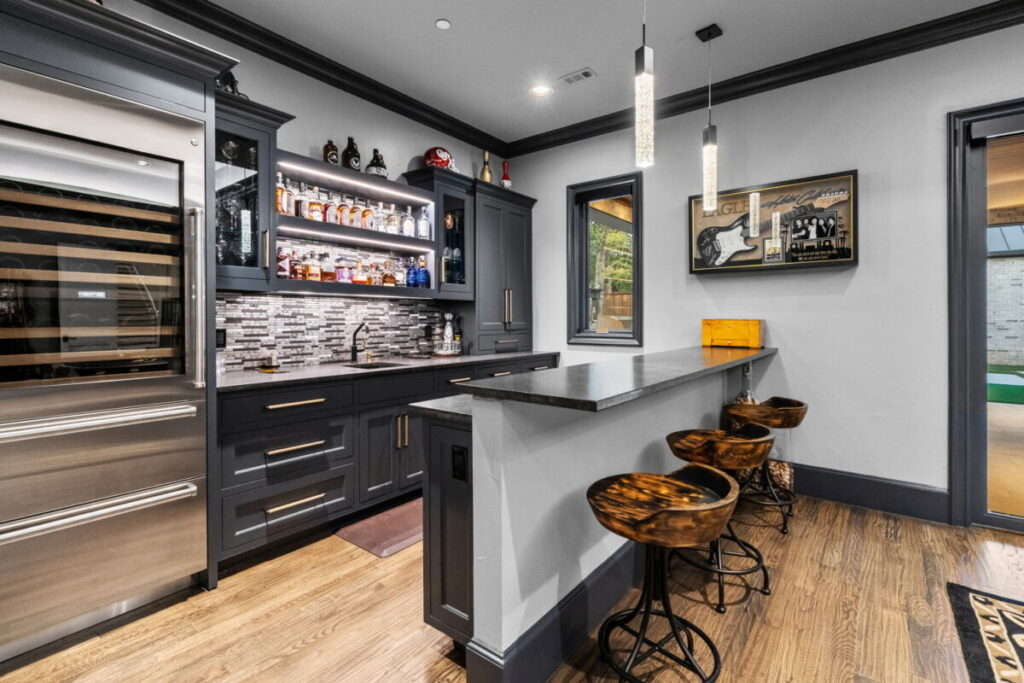
Upgrades that exceed market norms may not appraise dollar-for-dollar. Owners should understand this before committing to extreme customizations, like a wine bar.
Interest Rates & Rate Locks
Rate locks typically happen approximately 60 days from completion. No loan officer can predict rates perfectly. If they claim they can, they should be in a different business.
The role of the lender is to monitor trends and guide timing decisions — not guess the future.
Pledged Asset Loans & Margin Structures
Some Owners use pledged accounts. Be cautious:
- Many have a one-year clock
- Some require payoff at year end
- Additional collateral may be required if markets drop
Construction loans often eliminate that volatility. You make your down payment, then you build knowing what your rates will be.
Overage & Contingency
All custom projects have overages. Smart planning includes:
All construction loans state the Owner is responsible for overages. This ties directly in with change orders and resale value, which we discuss in later episodes.
Is There a Benefit to More Equity?
Yes — but it is modest. The difference between a 90% LTV and 80% LTV rate may only be approximately 0.25%.
Rates as of October 2025 are in the mid-to-high 6% range for construction loans. So, while better equity improves structure, the rate spread itself is not dramatic. Lenders are primarily evaluating:
- Quality of the project
- Quality of the Owner
Closing Thoughts
Does your head hurt yet? Financing a custom home can be overwhelming. If you are not familiar with the market, it can be challenging to connect all the pieces yourself. With the right team who knows the industry, this undertaking will be much easier. If you are preparing to build and want to align yourself with experienced lending partners, contact:
- Mark Goodwin of Federal Savings Bank
- Mark@MortgageMoneyMan.com
If you would like to begin the conversation about building your custom home, we invite you to sit down with us:
📲 Call Us Anytime At: 817.748.2669
📧 Email Us At: Info@GarabedianProperties.com